
3.5kW Hybrid Solar System with a 2.5kWh Battery: What Can It Power?
Choosing a solar system for your home is not just about buying an inverter and connecting a few solar panels. The real question is whether the system can support the appliances you need, store enough energy for backup and recharge effectively during the day.
At TRES Engineering, every solar installation is an opportunity to help homeowners understand how the different components work together.
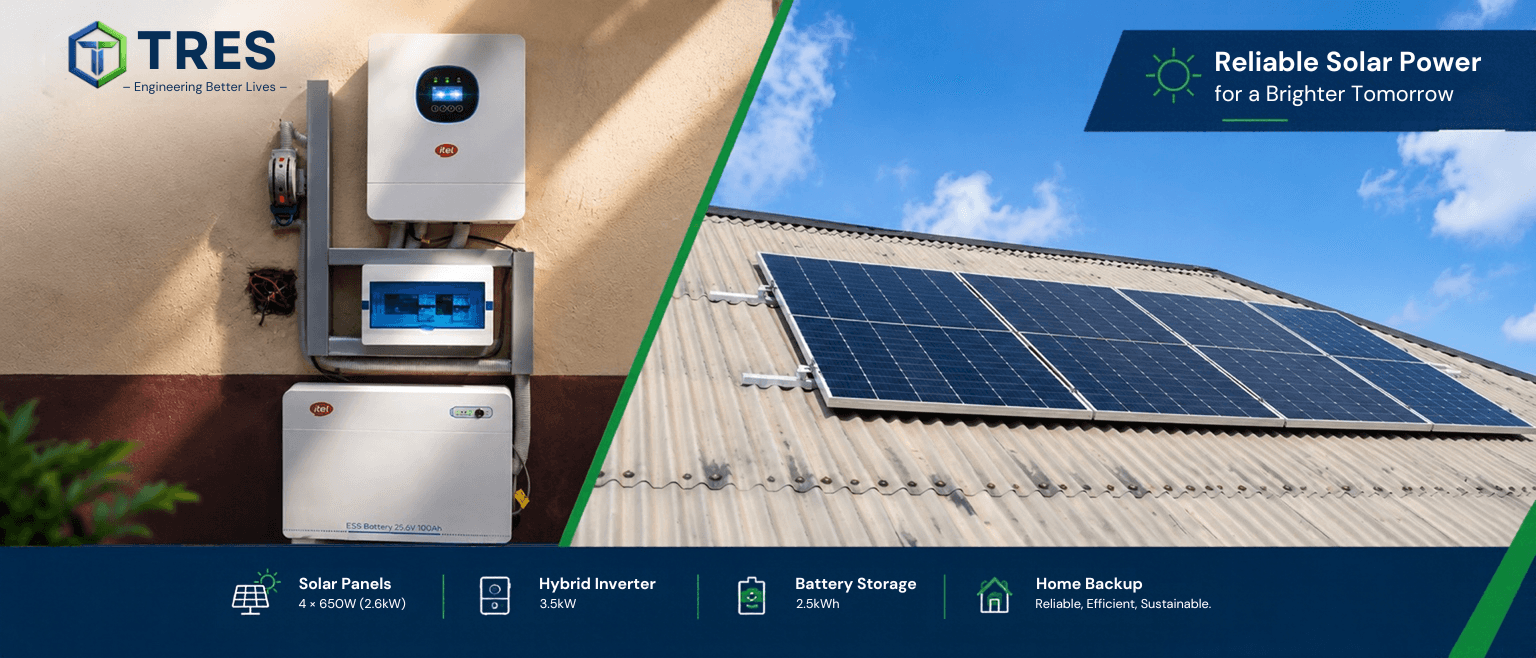
For today’s installation, the system specifications are:
- Hybrid inverter: 3.5kW
- Battery storage: 2.5kWh
- Solar panels: 4 panels rated at 650W each
- Total solar panel capacity: 2,600W, or 2.6kW
- Main purpose: Home backup
But what do these numbers actually mean for a homeowner?
Let’s break it down.
1. Understanding the 3.5kW Hybrid Inverter
The inverter is one of the most important components in a solar power system. It converts electricity from the battery into usable AC electricity for compatible household appliances.
A 3.5kW inverter has a nominal power rating of 3,500 watts. However, its actual operating limits, surge capability and supported loads depend on the manufacturer’s specifications.
This does not mean every home can run all its appliances at once.
Before connecting appliances, you need to consider their combined power consumption and whether any of them require additional starting power.
For example, lights, fans, televisions and routers generally have different power requirements from refrigerators, pumps and air conditioners.
The important lesson: Choose appliances according to the inverter’s capabilities, not just its headline rating.
2. What Does a 2.5kWh Battery Mean?
The battery stores energy for use when solar production is insufficient or when grid electricity is unavailable.
A 2.5kWh battery has a nominal energy capacity of 2,500 watt-hours. The amount of energy available to your appliances will depend on the battery’s usable capacity, its operating limits and conversion losses.
This distinction matters because power and energy are not the same thing.
- Kilowatts (kW) describe how much power a system can deliver at a given moment.
- Kilowatt-hours (kWh) describe the amount of energy stored or consumed over time.
A system may have a 3.5kW inverter but only 2.5kWh of battery storage. It may support a substantial load for a limited period, but heavier consumption will drain the battery faster.
How long could the battery last?
Consider these simplified examples, assuming the figures represent the total AC load and ignoring variations in battery capacity and inverter efficiency:
- A 100W load uses 100Wh per hour.
- A 250W load uses 250Wh per hour.
- A 500W load uses 500Wh per hour.
A nominal 2.5kWh battery contains 2,500Wh of stored energy. Actual backup time will be shorter than the simple capacity calculation suggests because not all stored energy is necessarily usable and the inverter consumes some energy during conversion.
The practical takeaway is simple: the more appliances you run, the shorter your backup time is likely to be.
3. Four 650W Solar Panels: What Is the Total Capacity?
Each panel is rated at 650W.
With four panels, the combined rated capacity is:
4 × 650W = 2,600W (2.6kW).
This is the panels’ combined rated output under specified test conditions. It is not a guarantee that the system will continuously generate 2.6kW in everyday use.
Actual production depends on factors such as:
- Available sunlight and weather conditions
- Panel orientation and installation angle
- Shading from nearby buildings, trees or other obstructions
- Panel temperature and system losses
- The inverter’s permitted solar input and operating limits
The inverter must be compatible with the panel arrangement. Before connecting the panels, an installer should verify the maximum PV voltage, current, permitted solar input power and the panels’ electrical characteristics.
Correct design matters just as much as the number of panels installed.
4. How Do the Inverter, Battery and Panels Work Together?
These components perform different but connected jobs.
During the day
The solar panels generate electricity when sunlight is available. The hybrid inverter manages the available power according to its design, configuration, household demand and battery charging requirements.
Depending on the system’s settings and operating conditions, solar energy may serve household loads while excess available energy charges the battery.
When sunlight decreases
As solar production falls, the system may draw on stored battery energy and, where available and supported by its configuration, another power source such as the grid.
During a power outage
A properly configured hybrid system with a suitable battery can supply compatible loads through its designated backup output.
However, backup operation depends on the inverter’s design, wiring, settings, battery condition and connected load. Not every output on every inverter is necessarily backed up during an outage.
5. Is This System Suitable for Your Home?
A 3.5kW hybrid inverter with a 2.5kWh battery and 2.6kW of rated solar panels may be a useful starting point for selected household backup needs.
Whether it is suitable for your home depends on what you intend to power and for how long.
Before choosing a similar setup, consider:
- Your essential appliances: List the devices you need during an outage.
- Their power consumption: Check the rated wattage of each appliance.
- Your expected backup time: Decide how many hours you need the system to operate.
- Your daytime usage: Consider whether solar production will support your loads and recharge the battery.
- Your future needs: If you may add more appliances later, discuss expansion options before buying.
A smaller battery may be appropriate for limited backup needs, while a household requiring longer overnight operation may need more storage.
There is no single configuration that is right for every home.
6. Common Mistakes to Avoid When Choosing a Solar System
Looking at inverter size alone
A large inverter does not automatically provide long backup time. Battery capacity and energy consumption are equally important.
Assuming panel wattage guarantees production
The total panel rating provides a useful starting point, but real-world output varies with sunlight, shading, temperature and system design.
Ignoring appliance starting power
Some appliances require more power when starting than when running normally. This needs to be considered when sizing the inverter.
Adding equipment without checking compatibility
Batteries, inverters and solar panels must operate within their specified electrical limits. Expansion should be assessed by a qualified installer.
Expecting unlimited backup
Solar power systems have practical limits. Good system design starts with realistic expectations about the loads, available sunlight and required operating time.
7. Why Proper Solar Installation Matters
Selecting the right equipment is only part of the job. A dependable installation also requires suitable cables, correctly rated protective devices, secure connections, proper earthing where required, and settings that match the connected equipment.
The installer should verify the manufacturer’s requirements, inspect the electrical connections and complete appropriate commissioning checks before the system is put into service.
These steps help protect the equipment and support safe, reliable operation.
Planning a Solar Backup System for Your Home?
Every home has different electricity needs. A setup that works for one household may not provide the same experience for another.
Before investing in solar, understand your essential loads, required backup hours, battery capacity and available space for solar panels.
TRES helps homeowners and businesses explore renewable energy solutions based on their power requirements.
If you are considering a hybrid solar system, speak with us about the appliances you want to power and the backup time you need.
Call or WhatsApp: 07033979488 or 09130703970
TRES — Engineering Better Lives.
Join the conversation
No comments yet. Be the first to share a thought.